
Don’t worry this isn’t really a post about golf as such, but about the notion of redefining fun. For addicts ‘fun’ can be found at the sharp end of a hypodermic needle, at the bottom of a vodka bottle, in the slots of a poker machine, or somewhere else that doesn’t sound particularly healthy. It is of course possible to do those things, if you really must, without getting addicted but it’s not advisable and generally doesn’t turn out well. And once you’re hooked of course, then you really are in trouble. One of the ways of treating someone who has become hooked, or addicted, is to redraw the parameters of what we find enjoyable and from what we take meaning. The place I’m receiving treatment, the Gunnebah Addiction Retreat, places a big emphasis on this approach, not just in the therapy on offer, but in the things we do on a daily basis, too. We’re asked, on a regular basis, to step out of our comfort zone a bit, do something that we might not normally do and see what happens. For instance, the other morning, there was a trip to a golf course planned that I fully intended to miss. I don’t mind golf, but I’m not very good at it and don’t know the rules, tactics or anything else really. It’s spelled G-O-L-F and is played over a large grass course by middle-aged men wielding clubs. And that’s pretty much where I’m at with golf.
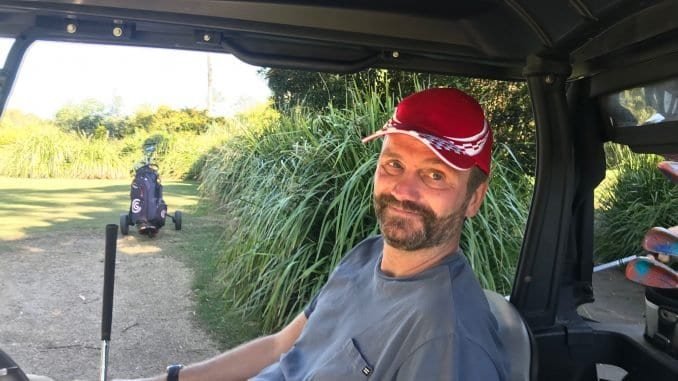
Anyway, intending to spend my day writing more of these posts, instead I was cajoled by a friend, who suggested that it was a lovely day and maybe I should get out of my head a bit. Not out of my head on vodka you understand, as would normally have been the case, but out of my comfy headspace and into something a bit different. So it was that I soon found myself bestriding the neighbourhood 9-holer, all sunglasses and baseball cap, a veritable Tiger Woods of the local recovery scene. Amidst much hacking, slicing, hooking and cursing, the occasional sweet spot was hit – a truly life-affirming feeling, by the way – holes in two, if not one, were achieved and good natured insults and banter swapped. Beaten into third place in a field of three wasn’t exactly my finest sporting hour, but a pleasant time was spent and a feeling of good-humoured accomplishment achieved. I’ll probably never be a regular golfer, let alone a decent one, but the point was made: There I was having a perfectly good time with my friends, without even thinking about having a drink. I’ve only just realised it but the thought never once crossed my mind. Any embarrassment I felt at sending yet another divot flying through the air whilst the ball remained untroubled on its tee, was evened out nicely by the release of serotonin that comes with a successful shot and the simple pleasure of strolling slowly through grassy parklands, observing the day around me and considering the mechanics of my next shot.
‘Stop rushing’, said my golfing companion Warwick Parer, the director of Gunnebah. ‘Take it easy. Stop being so hard on yourself.’ Of course, if you’re like me, everything is a rush and every moment a fresh opportunity to beat myself up about something. ‘Fucking Hell!’, I screamed as my second shot over the water trap met the same watery end as the first. The third attempt missed the water entirely but was sliced wildly, ricocheting off a tree with a sharp clunk before landing in the middle of someone else’s fairway. ‘It’s just a game’, shouted Warwick after me, as I ran off cursing to retrieve it.
And so it is. But there’s a point to this pleasurable mayhem, which involves re-wiring our addled brains so that we’re not always caught up in the fierce loop of addiction, where every failure and every celebration ends up at the sharp end of a needle, or with the need to walk straight off the fairway and into the club bar. As a world authority on addiction and relapses, I’ll hand the point over to Dr Steven Melemis, who says this:
‘One of the important tasks of therapy is to help individuals redefine fun. Clinical experience has shown that when clients are under stress, they tend to glamorise their past use and think about it longingly. They start to think that recovery is hard work and addiction was fun…The cognitive challenge is to acknowledge that recovery is sometimes hard work but addiction is even harder.’
Addicts forget that it’s possible to enjoy even the simple pleasures of life without a large dose of poison close to hand. That a stroll in the country can be just that, a quietly mindful and life-affirming experience that exists in its own time and space and requires nothing more than to be noticed and enjoyed as it passes by. Slowly, I’m learning to adjust to this different rhythm, to this way of rewiring my hard-wired brain. It’ll take time, years even, and some of it won’t be easy. There’ll be setbacks along the way, dark moments, yearnings and despondencies. But the more you do of this, the more sweet spots you hit, the sooner things change and before you know it, the wild slice into the trees, becomes a straighter drive down the fairway of life. Every frustrating water trap doesn’t have you dreaming of where your next consoling drink might come from, and every victory doesn’t need to be accompanied by a glass of champagne. The warm glow of quiet, inner accomplishment might – just might – be enough of a win on its own.
One day at a time.

Be the first to comment