
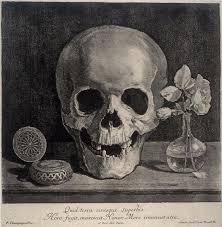
I badly wanted a skull. A real one too, taken from the body of a dead human. I’d gone so far as to try and source one, get a price, y’know, find out what the deal was with skulls and how to get my hands on one. The internet being as it is, I’d found some for sale. But the price! I can’t recall exact numbers but it was in the high hundreds and not a viable option. And a plastic one wasn’t going to cut it. It had to be the real deal. Ah, forget about it, I thought. Who needs a skull anyway?
Perhaps, at this point, some context would be helpful.
Winding forward in time nearly an entire generation, I found myself a world away, a raging alcoholic, living in a creaking old ghost house in the Australian bush. How I got to be there is a tale for another time, but it was there and then that I happened across a coin. Or more correctly, I happened across a ‘sponsored’ page on Facebook trying to sell me a coin. I recognised it as the thing I’d been looking, in one form or another, for a very long time. For on one side of the coin was inscribed the Latin phrase, ‘Memento Mori’ – ‘Remember you will die’ – framing no less than the engraving of a skull. With a Proustian rush, my lost world of internet skull hunting came flooding back. What I had wanted from the skull all those years back, was exactly here on the coin: a memento mori, a reminder to myself that I, and all of us, will die.
Legend has it that all-conquering Roman generals would be paraded on a chariot through the streets of the city to the adoration of vast crowds, whilst a slave whispered in the hero’s ear, ‘Remember thou art mortal’. A thing that’s perhaps easy to forget if you’ve just finished up conquering most of the known world.
Anyhow, my personal interest in the notion of a memento mori came from a painting I’d seen years before of Lord Byron looking at a skull on his writing table. I can’t remember the exact scene, but I imagine Byron with a quill in one hand, his chin in the other, gazing meaningfully at the reminder of his death that lay before him.
Shakespeare as well, gave us his immortal take on the thing, as Hamlet – torn by intense self-doubt – literally holds before him the skull of his friend Yorick and speaks to it, reflecting also to his friend Horatio on the meaning of life and loss:
‘Alas, poor Yorick. I knew him, Horatio; a fellow of infinite jest, of most excellent fancy…’
This was what I was after. A reminder that death comes to us all. But, for both the younger and the later me, I’d always considered a memento mori to be simply a warning of the state to come, nothing more. But the coin on the Facebook page gave me something more, something that has helped fuel my purpose to this day. For on the flip side of it was another phrase, in English this time but framed this time in Roman laurels: ‘You could leave life right now’.
A bit of internet clickery-pokery soon brought me to the full quote, which is taken from the Roman Emperor and Stoic philosopher, Marcus Aurelius (if you’ve seen Gladiator, the Emperor at the beginning of the movie, played by Richard Harris, is meant to be Marcus):
‘You could leave life right now. Let that determine what you do and say and think’.
Having been on a depressive downward spiral for some time, I had long since given up on epiphanic notions of sudden revelations and lightening-miracle cures. Nonetheless, this understanding sent a bolt of realisation through me. Of course, a memento mori wasn’t just a morbid token, but nothing less than a mighty call to action in the face of the only thing we know for sure in life: death itself.
Speaking across the ages, Marcus was saying something so simple and yet so profound that even my addled mind could see it clearly. What a terrible waste this all is, I though. Laying, as I was, on a floor piled high with empty wine bottles (three black bin bags full, I later discovered), I saw now the futility of all this. Not of life, but of drinking myself to death. It framed something in my mind that I could see more clearly now, a thing I could act on. And whilst it took a few more months before I finally – and with the help of others – sobered up, I’ve remained a convinced Stoic ever since, with Marcus Aurelius taking his rightful place in my long list of personal heroes.
As for the coin, I never did get round to ordering it off the Daily Stoic website, although I may do one day. But more importantly, I’d learned a lesson that will stay with me for however long I’ve got left of life: live now, for death comes tomorrow.

Be the first to comment