
‘You see I usually find myself among strangers because I drift here and there trying to forget the sad things that happened to me.’
F. Scott Fitzgerald, The Great Gatsby
When I was probably much too young to be interested in such things, I recall reading a short story by Scott Fitzgerald called, The Lost Decade. This particularly brief tale was one part of a slim collection of the great man’s stories, which – alongside many other books also worth reading – used to grace my mother’s extensive bookshelves. Growing up around books as I did, from an early age I was fascinated, at first not by the words, most of which were way beyond my youthful literary pay grade, but by the covers. I recall a particular obsession with the weird, demonic swirls that adorned the crumbling face on the cover of, The Picture of Dorian Gray; the rustic scene that depicted Russian rural life under the Tsars, in Mikhail Sholokhov’s Cossack epic, And Quiet Flows the Don; people washing their clothes by a depiction of a historical River Ganges from EM Forster’s, A Passage to India, and, of course, the two men in 1920s suits, who sat across a table from one another on the cover of The Lost Decade.
That I was to go on and read all these books and more at a young age, is a testimony both to my mother’s excellent taste in literature and, I guess, my own status as a relatively precocious, and certainly very curious, reader. But it was the pictures and colours that got me first, and I distinctly remember that the Fitzgerald cover image intrigued me. And so, at some stage in my upbringing, I opened the book and read the title story, which – again I remember this specifically – was endearingly short and so, for the young and fickle reader, an easy pick.
Given the circumstances in which I found myself, which is to say being brought up in an alcoholic household, The Lost Decade, proved to be a particularly apposite choice. At the time I had no way of knowing that the author, Fitzgerald himself, was one of the 20th Century’s great literary alcoholics, although sadly I was all too familiar with the condition from which he suffered. I don’t want to dwell here on my mother’s drinking, except to say that it was what alcoholism always has been: a sad, and sometimes desperate, condition that deeply marks the lives of all who encounter it. And what I found in The Lost Decade, was – I think I’m right in saying – my first literary collision with the condition and, unsurprisingly, it made a lasting impression.
What happens in the story, is that a young journalist named Orrison Brown, is asked by the newspaper’s editor to accompany a business visitor, Louis Trimble, to lunch. Used to such assignments and thinking little of it, young Brown escorts the older man into the streets of New York, engaging him in polite small talk and enquiring where the guest might like to dine. Along the way, however, Brown is struck by the ambiguous answers he receives from his guest, as Trimble admits to being familiar with the neighbourhood, whilst alluding to not having not been there much over the last few years:
‘They reached the street and the way Trimble’s face tightened at the roar of traffic made Orrison take one more guess.
“You’ve been out of civilization?”
“In a sense.” The words were spoken in such a measured way that Orrison concluded this man wouldn’t talk unless he wanted to–and simultaneously wondered if he could have possibly spent the thirties in a prison or an insane asylum.’
As the two men wander the streets, this little mystery deepens, as Trimble continues to reference scenes and people with which he seems both familiar and oddly distant from. At last, as the two part, the truth is revealed, when Trimble casually reveals that, whilst he’s lived and worked in this very neighbourhood and hasn’t ‘gone’ anywhere as such, he’s been drunk for the last ten years. The lost decade of the title suddenly sharpens in the reader’s mind, and also in Orrison Brown’s, who ends the story by reaching to touch the stone of a nearby building, as if to take closer hold of the senses that Trimble had, for the last ten years of his life, abandoned.
It’s a moving tale, and one that had real resonance for this son of an alcoholic and, of course, fellow sufferer in making. That I was later to experience my own lost decade for the same reasons of course didn’t, and couldn’t have, occurred to me at the time. It is a firmly adult story, and I was little more than a child, for whom the future held no fear.
Looking back on all this, it does take on a certain sickly inevitably. There I was, the child of a well-read alcoholic, who would go on to become a well-read alcoholic himself, being drawn eerily to a story written by, you got it, a well-read alcoholic. I mean, whatever, and real life symmetries are rarely this neat, but there’s little doubt that this one chimes nicely with my purpose here. It’s tempting to see the major theme of The Lost Decade, as simply and straightforwardly that: of time and memory, lost. But as with much great art it’s what remains unsaid that speaks to us just as loudly, perhaps more so, than the things we hear and see. As someone who has lived within his own darkened, half-remembered realm, the message is loud and clear: although we may see the things in it over and over again, in a fundamental sense, we see this life only once, and it never comes again. And for those who choose not to heed the warning, well, the lost decade awaits.
Nick Jordan
You can read The Lost Decade, by F. Scott Fitzgerald here.
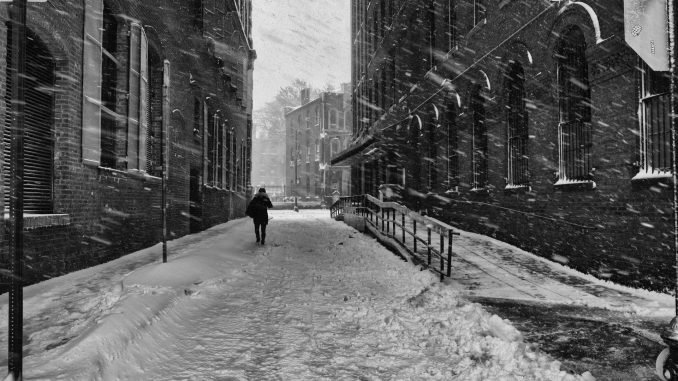
Photo by Jeffrey Blum on Unsplash



Be the first to comment