
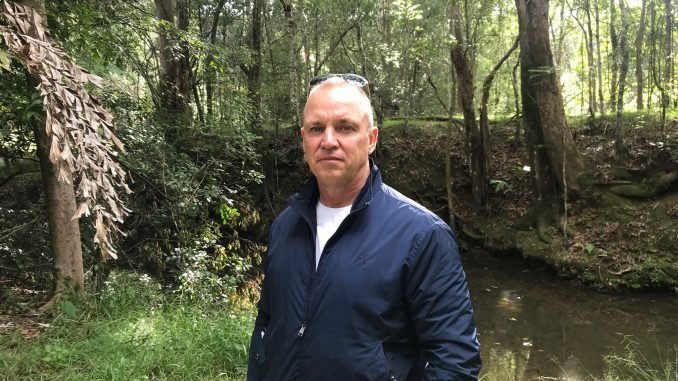
‘I always wanted to grow up to be a bank robber’, says Russell Manser candidly. ‘Where I come from the only blokes getting ahead were the ones robbing banks, driving around in stolen cars. I wanted a bit of that.’
When I first arrived here at the Gunnebah Addiction Retreat, one of the first people to help me was Russ. Arriving pretty much broken and with literally the clothes I stood up in, Russ didn’t hesitate to make me feel welcome, buy me some new shoes and give me some money to buy some shirts, shorts and so on. Whatever else happens to me in this life, I won’t forget Russell’s straightforward kindness in a hurry. ‘On addict helping another, brother’, he said. ‘Just pay it forward’.
An Aussie character if ever there was one, Russell Manser has, by any normal definition of the word, led an extraordinary life. The youngest of six children, Russ grew up in the tough Western Sydney suburb of Mount Druitt, ‘the Bronx of Sydney’ as he calls it. His parents are British, some of the ‘Ten Pound Poms’, who migrated to Australia in the aftermath of the Second World War. His mum, he says fondly, still speaks with a broad Scouse accent: ‘Are Russell’, as he’s known to her.
But from an early age he says, he knew he was different from his siblings. None of his brothers or sisters have ever been in trouble with the law, in fact one brother even worked as a prison warden. But, for whatever reason of upbringing, nature and environment, Russ was drawn towards another kind of life, a different way forward. And not the easy one either.
A skilled boxer and fight trainer Russ says that, against a backcloth of urban blight, boxing was always a staple of his existence, something reflected in his choice of heroes, which includes Muhammed Ali, most of the great fighters you’ve heard of and some you haven’t. ‘People that get knocked down and get back up again’, he notes (you’ll not be surprised to learn that the famously tenacious Australian outlaw Ned Kelly features on the list too).
Despite the disciplines of boxing, at age 14, Russ soon found himself in Western Sydney’s notorious Daruk Boys Home, scene of an appalling, decades-long child abuse scandal, the repercussions of which are still rippling through Australian society today. In the words of Glenn Cooper another former inmate interviewed by the ABC, ‘the facility was supposed to be an institute for rehabilitation but as a result of the treatment by wardens, all of the boys grew into criminals’. Russ was to suffer both of these fates, falling victim to institutional sexual abuse at an early age and going on to lead a life of crime, interspersed with extensive periods in jail – 23 years overall. But re-offending wasn’t the only factor at play, in an increasingly complicated young life. At Long Bay Correctional Centre in Sydney (the ‘Long Bay Hilton’), a 16 year old Manser was introduced to heroin. Upon his release, he took back to what he knew and started robbing banks to support his rapidly blossoming addiction until, aged just 21, he found himself on the receiving end of a 15 year jail sentence. Escaping from a prison watch house in the Northern Territory, by simple virtue of thumping the detaining officers and legging it, Manser went on the run, only being picked up again after robbing another bank two years later. ‘I was in and out of jail so often, I can’t even remember the details’, he says.
Released in 1998, for ten years Russ kept his nose clean before again falling – as addicts sometimes do – to another relapse and yet another conviction and jail sentence for armed robbery. But while he was in jail, this restless, wayward but intelligent man, found a purpose that was to define his life more fully than any robbery or drug ever had.
Established in 2013, the Royal Commission into Institutional Responses to Child Sexual Abuse set forth on its mission (which, predictably, was opposed by the then Prime Minister Tony Abbott) to investigate the hidden scandal that had plagued Australia’s penal and other institutions for years. A survivor of such abuse himself, Russ gave private testimony to the Commission. Upon his release from jail, he founded his company The Voice of a Survivor which works to gain legal acknowledgement and recompense for the victims of institutional sexual abuse, to give them a voice and help them rebuild their lives. Russ says:
‘A perpetrator’s greatest tool is his victim’s silence. When I started this business I took someone’s shame and handed it back to the perpetrator.’
Now armed, not with a weapon but a degree in law, and with abuse survivors clamouring for help, Manser and his team of lawyers and case managers currently work with over 1,700 clients, to get letters of apology and reparations. Asked about his own criminal past, Russ is clear:
‘I’m truly remorseful for what I did. But I’m a dirty rotten criminal who owns his stuff. In part this is my way of paying society back for the hurt I caused. It’s a good karma job.’
It’s a sad reality of modern Australian life that many urban and rural Indigenous communities are blighted by poverty and crime. But Manser grew up in such an environment and his company has a ‘big heart’ for Aboriginal people, many of whom are now clients who he represents. Inspired by the work of Indigenous writers and activists such as Vincent Lingiari and Chris Sarra and mentored by the world famous polymath, Professor Ian Coyle (who also worked with the Royal Commission), Manser is tireless in his support for Aboriginal people, survivors in their own right, who may need his help and encouragement.
For obvious reasons, lots of people at rehabilitation centres such as this one are reluctant to tell their story for fear of being identified. Addiction still carries with it a terrible social stigma, another reason why addicts find it so hard to break the cycle. One of the reasons I’m writing this journal is to make a very small contribution to breaking down those barriers to recovery and I suspected Russell would feel the same. In response to the question, ‘What can’t I say?’, he was quick to respond. ‘Nothing. Tell them everything, I’m an open book’.
For me, it’s attitudes like this – what therapists might call a ‘growth mindset’ – that will help us heal a broken society. If we refuse to accept that addicts are worthy of the same dignity and respect as the rest of us, then they may never get better and remain a hidden problem. By his work and his outlook on life, Russell Manser took a different view, refused to be beaten, opened himself to change and found a way to help others, help themselves.
One day at a time.
Photo by Nick Jordan
Fuckin powerful read ,I’ve just finished 9yrs and am on the run already lost my kids my life my purpose and this has me in tears. Why can’t I do it. I can.
You definitely can do it my friend. If you want to speak to someone in total confidence, let us know.