
Since I started this journal a number of people have messaged me, saying that these posts have caused to them to have a think about their own relationship with alcohol, which is a humbling and – dare I say it – sobering thing. Thank you for your messages and I’ll help as best I can. Helping you helps me too, so don’t be afraid to ask.
I can only really speak from my own experience, but if you are struggling then I’d advise you to think about getting some help sooner rather than later. Or, even better, right now. I recall an interview on the BBC with Dr Sally Davies, the Chief Medical Officer of England, in which she freely admitted to having a complicated relationship with alcohol herself. What stopped her drinking, she said, was her own research on the devastating effects that alcohol can have on body and mind. I can’t remember her exact words, but she basically said it was an outright poison that will kill or damage you irreparably, if it gets its talons into you. Alcoholism is a fatal disease if left unchecked. Which is a shame if you like more than a few drinks and even more of a shame if, like me, you’re a raging alcoholic.
As I’ve said before, I’ve been a member of Alcoholics Anonymous for around two years, which has produced extended periods of complete sobriety but, overall for me, mixed results. This isn’t the ‘fault’ of AA as such, but rather my own unwillingness or inability to fully embrace the program at this stage. Essentially, I have mixed feelings about it. But if you do feel the need to get help with your drinking, I’d urge you to give AA a go (or NA if you’re into drugs, or both if you’re struggling with both). What I can tell you about the fellowship is this:
• You’ll be treated with kindness and respect from the outset.
• There’s no charge; you need never pay a penny to attend a meeting unless you choose to donate.
• It’s not a cult (but I can see how that misunderstanding might arise).
• You will hear stories that will make you hair curl and, selfishly perhaps, make you feel a bit better about your own behaviour. Whatever it is you’ve done or feel bad about, someone else has been there and done that, even more lavishly than you can ever imagine.
• Your anonymity will be respected completely. You don’t have to give your real name, sign anything or leave any other evidence that you were there.
• There’s no obligation or pressure to go back if you choose not to. No one will contact you and urge you to re-attend, unless you ask them to.
• You might be asked to share your story, but don’t have to.
• You don’t have to identify as an alcoholic if you don’t want to, but given that you’ve just walked into a meeting of Alcoholics Anonymous, then, well, y’know.
• It’s ok to be drunk at a meeting, just don’t share and start rambling on like the drunken bastard that you really are.
• Meetings can be much more light-hearted than you may think.
• There will be mention of God, a higher power, and the use of prayer, so be prepared for that.
• At end of the meeting everyone gathers together, holds hands and recites the Serenity Prayer (see below). Don’t be embarrassed it’s fine, but you don’t have to do it if you don’t want to. Personally, I always find it very moving.
• It’s not like the movies. It’s way more interesting than that.
If AA isn’t for you, there are other forms of therapy available, most notably SMART Recovery, which I’ve also tried. SMART stands for Self-Management and Recovery Training and, in terms of how it approaches your problem, it works almost exactly the opposite way around to AA:
• SMART meetings are counsellor-led sessions, whereas AA is group led.
• There is no charge for attending a meeting and you’ll be treated with the same respect and goodwill as at an AA meeting.
• SMART teaches you techniques to manage and take control of the problem, where AA suggests you abandon attempts at control and hand it over to your higher power: ‘Let go, let God’, as they say.
• As such SMART takes a scientific approach to recovery, as opposed to the spiritual approach adopted by 12 Step programs such as AA and NA.
• It teaches self-reliance, not powerlessness. AA asks you to accept that you are powerless over alcohol.
• SMART avoids using labels such as ‘alcoholic’ or ‘addict’. AA embraces them.
• It’s more discussion based, whereas in AA each sharer listens to the other without interruption. It’s bad form to ‘crosstalk’ in AA, whereas SMART encourages a chat.
• Basically, aside from the group setting, it’s totally different from AA.
You can easily find links to both these organisations and meetings near you, with a quick Google. Wherever you are in the world, I can also put you directly in touch with someone from AA to talk to if you wish. Or just use their website and give them a call yourself, you’ll get a friendly and helpful response. Same with SMART. Both these organisations can help you get sober, if that’s what you want.
Other ways of helping yourself are by going to your GP and being completely honest with them about what’s happening – and I do mean completely honest. Don’t lie about how much you’re drinking, which addicts often do, just tell them the ugly truth. They can help with blood tests, certain medications and refer you to a shrink or rehab facility. Blood tests will measure the enzyme levels in your liver which, if too high, can lead to liver disease which can be fatal. It’s a literally sobering experience to be told your liver is red lining and that you need to stop drinking right now. Good news is that the liver is a tough old boot and, if you stop drinking, your liver count may go right back down again and you’ll be fine. Try not to use a restored liver count as an excuse to start drinking again, which lots of alcoholics do. Instead thank your body for having a magnificent capacity for self-repair and go and get help for your drinking, because if you carry on there will come a point where your liver gets damaged beyond repair, and then you are in trouble.
Some doctors still think that alcoholism is a moral problem, a choice you make. If you get that vibe, leave immediately, find a proper doctor who knows what they’re talking about and can actually help. Alcoholism is a disease and is classified as such by the World Health Organisation.
Medical science can’t cure alcoholism, but it can assist your passage through recovery. Either way up, if you don’t stop drinking heavily you’ll end up with doctors one way or another, quite possibly with them telling you that you have only six months left to live. A friend here at rehab was once told that she had only six weeks left to live if she carried on drinking. She stopped (some don’t) and is still here with us today.
At the rehab centre here we use group and individual therapy and techniques such as Cognitive Behaviour Therapy (CBT), mindfulness and what I might term ‘positive distraction’ where, alongside the therapy sessions, you’re encouraged to take part in group activities that are nurturing, fun and relaxing and you re-learn how to enjoy life without the need for alcohol. We’ve got a murder mystery game going tonight for instance, in which I’m required to put on a French accent and dress up as a woman (complete with beard). Other rehab centres are like boot camp with rigorous, military and religious style structures and definitely won’t get you cross-dressing for fun. Such is the varying nature of the recovery game.
However you choose to get yourself well, if you are worried, don’t hesitate to look into it straight away. I can’t emphasise enough how fully alcohol can destroy, or end, the lives of those addicted to it.
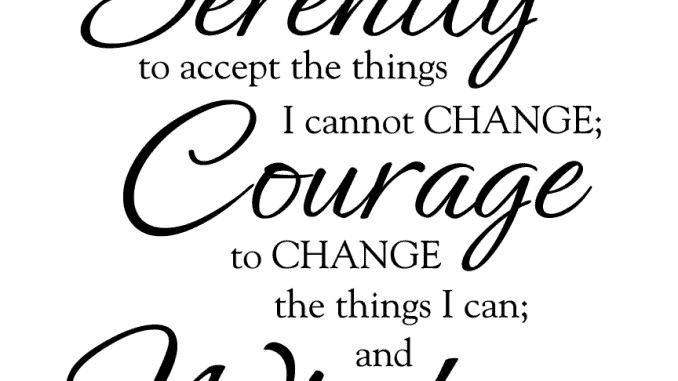
I mentioned above the Serenity Prayer, which is said at the end of every AA meeting worldwide. It took me a long time to get my head around it, because I couldn’t work out how it pertained to alcoholism. I understand better now, but I also think it’s a useful (and beautiful) prayer or mantra for many of the predicaments that we encounter in life. So I’ll finish on those words:
‘God, grant me the serenity to accept the things I cannot change, courage to change the things I can, and the wisdom to know the difference’.
One day at a time.

Be the first to comment